Every day, thousands of vehicles cross a certain bridge on State Highway 180 in Fort Worth. What most don’t realize is that by crossing this span, motorists are taking part in a potentially life-saving experiment.
Geothermal heat pumps below the bridge warm the surface, stopping the accumulation of ice and snow.
A new case study from the U.S. Department of Energy details how the University of Texas at Arlington’s geothermal heat pump project makes wintertime driving safer for North Texans. The study said the pump system provides an alternative to salt and sand, reduces maintenance costs and potentially saves lives.
The project’s origins
The pump project dates back to 2015. That’s when University of Texas at Arlington civil engineering professor Xinbao Yu and Texas A&M University civil and environmental engineering professor Anand Puppala first proposed investigating the use of geothermal heat pumps to prevent snow and ice on bridges. The Texas Department of Transportation funded the professors’ work.
The professors carried out the project in two phases.
In the first phase, which ended in 2016, the professors validated the concept.
In the second phase, students and postdoctoral researchers at UTA Fort Worth and Texas A&M gauged the effectiveness of the geothermal pump system. The phase used a no-traffic mockup bridge — at U.S. Highway 287 and close to the UTA Fort Worth campus — to test the effectiveness of geothermal heat pumps.
Researchers put the pump-equipped mockup through its paces during wintertime in 2019, 2020 and 2021. The bridge remained ice-free during the catastrophic Winter Storm Uri in 2021, Texas A&M said.
“Moving forward, we hope to prove that this technology is ready for large-scale use,” Yu said at the time.
Real-world de-icing test
Yu subsequently received nearly $636,000 from TxDOT for the installation of a geothermal loop system beneath the deck of a full-size bridge used by vehicles. Four geothermal heat pumps at the SH 180 bridge in Fort Worth protect 4,300 square feet of surface space. That’s roughly the size of a standard 10-car parking lot, the study said.
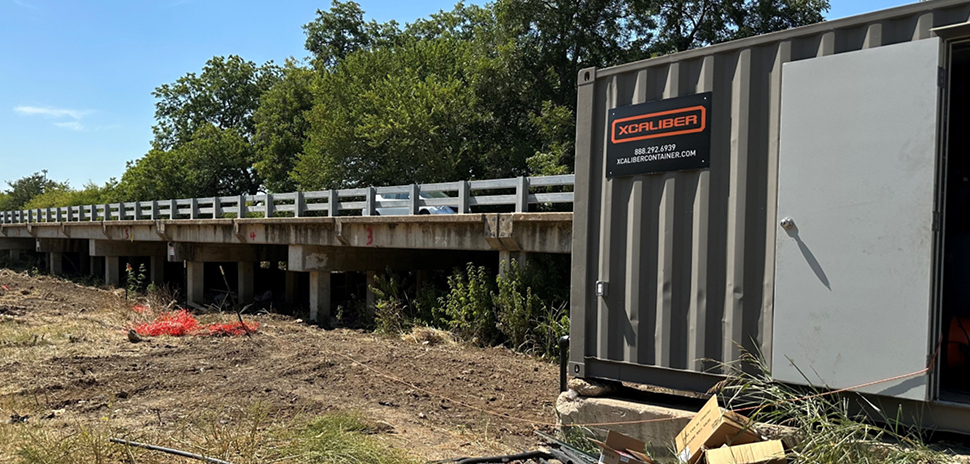
Under the SH 180 bridge, geothermal pipe loops heat the deck. The loops circulate warm, geothermally heated 100-degree fluid that prevents snow and ice from accumulating on the bridge, the study said. A nearby control room contains heat pumps, monitors and other equipment, including a thermostat that automatically turns on the system.
‘On-the-spot de-icing solution’
The federal study called the system an “on-the-spot de-icing solution.”
“This not only ensures driver safety,” the study said, “but also provides a reliable on-site alternative to chemical deicing and the corrosion that results from using these compounds.”
Installing the pipes under a bridge deck instead of embedding them in concrete during bridge construction means leaking pipes can be easily repaired, the study said. Another benefit: Foam-core insulation covering the pipes ensures efficiency. How? Heat generated by the system goes directly to the bridge deck instead of escaping into the air.
“Because the system tubing is installed beneath the bridge deck, existing bridges anywhere can be retrofitted with similar geothermal heat pump systems to keep drivers safe worldwide,” the study said.
Yu said in the study that the pump system “is sound, safe and efficient.”
“We took the idea of using geothermal heat pumps for bridge de-icing to the next level, creating an optimal way of de-icing using innovative materials and applications,” he said.
R E A D N E X T
-
 The DEC Network Partners With Charles Schwab Bank to Expand Services for Entrepreneurs in Fort Worth
The DEC Network's updated Fort Worth space accommodates Spanish-language workshops, coworking and more.
-

TxDOT’s Project Nexus aims to bring air taxi service to Dallas-Fort Worth and the rest of the Texas Triangle by 2029.
-
Ranchbot, a provider of real-time, satellite-based technology for water monitoring for livestock producers, plans to use some of the funding to grow its agtech portfolio.
-

International conflicts are helping propel Lockheed Martin’s aircraft program in Fort Worth and missile program in Grand Prairie.
-

New CBRE research points to a maturing tech workforce in North Texas, fueled partly by the Y’all Street financial services boom.
-
The airline is opening its collection of more than 1,000 9/11 artifacts to the National September 11 Memorial & Museum in New York City. It also is supporting The Never Forget Fund and the planned National 9/11 Pentagon Memorial Visitor Education Center.
-

Joseph Rainone previously served as CEO of the e-commerce furniture company Ubique Group. He also held leadership roles at Melissa & Doug, Bayer and Hasbro.