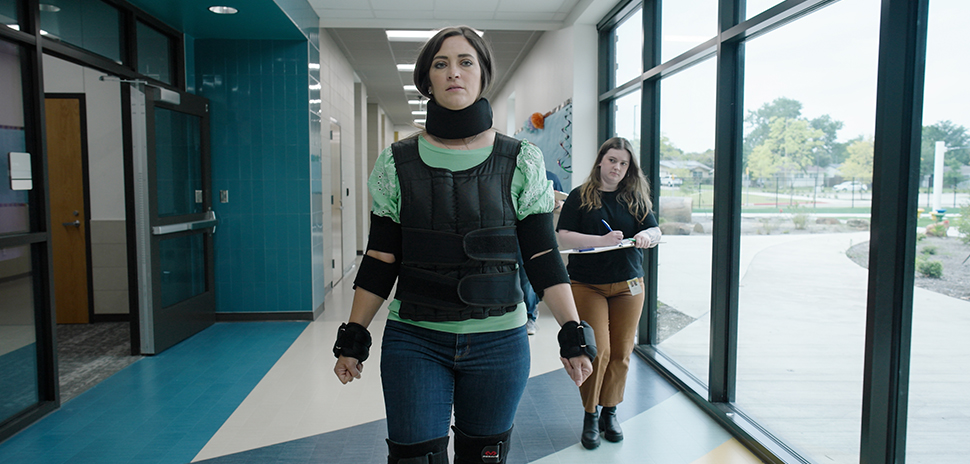
Dallas-based architecture and design firm Corgan has released new research aimed at helping close what it calls an “empathy gap” in the inclusive design of schools. Most learning environments, the researchers found, are designed with students as the primary focus. But the needs of educators, particularly those with disabilities, also are important.
The firm’s education team and its in-house research and innovation group, Corgan––Hugo, conducted 77 surveys and 41 interviews with educators with disabilities, as well as on-site simulations at a Corgan-designed elementary school in North Texas of visible, invisible, chronic and temporary disabilities or limitations.
The on-site research participants used goggles, earmuffs, weighted clothing, thick gloves and a gerontological, or GERT, suit while navigating Arlington Independent School District’s Thornton Elementary School. These tools simulated a variety of conditions, including arthritis, aging, temporary injuries and pregnancy, creating a sense of the lived experiences of educators with disabilities and medical conditions.
Quantifying the challenge
The findings were stark. Simulated conditions such as aging, pregnancy and chronic illness meant:
Common teaching tasks were nearly twice as difficult.
Teachers’ confidence in their ability to perform their jobs declined approximately 14 percent.
Mental effort increased roughly 36 percent.
Overall mood declined 27 percent.
“Campuses have made strides toward inclusivity, particularly in supporting students with diverse needs,” said Chloe Hosid Sloan, education design researcher at Corgan, in a statement. “This research goes further by asking how learning environments can also better support the educators with settings that foster capability, comfort and longevity in the profession.”
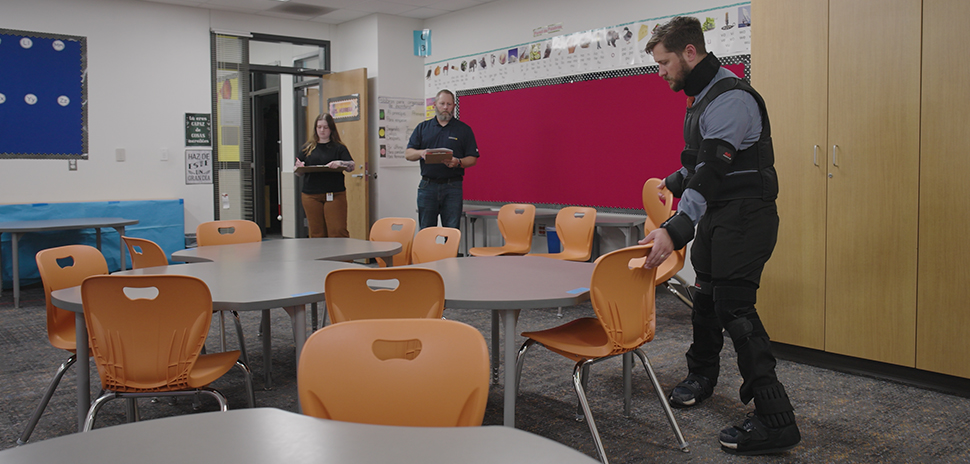
A simulation participant completes a classroom task while wearing gear designed to mimic mobility and sensory limitations. [Photo: Corgan]
Putting the research to work
The American Society of Interior Designers (ASID) Foundation funded the research. Its $30,000 grant is part of the nonprofit’s mission promoting interior design “to demonstrate and celebrate the power of design to positively change people’s lives,” according to its website. Its grant program supports research projects that lead to the creation of educational resources for interior designers.
The Corgan researchers’ findings are the focus of a new design guidebook for administrators, district leaders and design teams. The guidebook provides practical strategies, based on Corgan research, that can be applied to both new construction and existing educational facilities, the company says.
Some key recommendations and insights from the report include the need to design for low effort to support educators’ endurance. That may mean planning and reorganizing classrooms and other areas to reduce unnecessary efforts like lifting, walking and reaching, which would help improve educators’ physical capacity and reduce fatigue during the school day.
Flexible systems that include things like personalized equipment and reconfigurable zones are also crucial, the researchers found, so educators can adjust to their environments. And designing for cognitive clarity, with things like intuitive organization, thoughtful acoustics, and clear distinctions between active and quiet zones, can help minimize distractions and allow for better focus throughout the day.
“By grounding innovation in real educator experiences, this work moves research into action,” said Melissa Hoelting, assistant director of Corgan—Hugo. “Our goal was to transform findings into practical guidance and design strategies that ultimately help teachers thrive in their environments, not just endure them.”
Don’t miss what’s next. Subscribe to Dallas Innovates.
Track Dallas-Fort Worth’s business and innovation landscape with our curated news in your inbox Tuesday-Thursday.
R E A D N E X T
-

The Dallas-based digital marketing agency said it plans to extend its “Content Everywhere” framework to Plano Website Design’s clients as more people turn to ChatGPT, Gemini, Perplexity, and other AI tools before using traditional search engines.
-

The ranking came from Nature Index, which tracks health care research articles published in top science journals, offering a snapshot of landmark discoveries from 6,545 institutions around the world.
-

Slated to open by the end of 2026, the Dallas facility will serve as a hub for advanced research, design engineering, and small‑scale manufacturing, Kopin said. The center will include new optics and photonics lab space; a dedicated design and engineering center; advanced R&D capabilities focused on Neural I/o; and manufacturing capacity for Kopin's Neural I/o and ASOS systems.
-

Paragon—which was acquired by Atlanta-based Mirion in September for $585 million—designed a Highly Integrated Protection System for the NuScale Power Module, "the first and only small modular reactor design" currently approved by the U.S. Nuclear Regulatory Commission, according to the company.