Researchers at the University of Texas at Arlington and UT Southwestern Medical Center in Dallas are using AI and advanced statistics to pinpoint the molecular “control switches” involved in several eye diseases.
The diseases being studied include age-related macular degeneration, glaucoma and diabetic retinopathy.
“These diseases affect different cells and biological processes, but share a fundamental question: What goes wrong with the molecular ‘control switches’ that regulate gene activity?” Sherry Wang, a UTA professor of statistics and data science, told Dallas Innovates.
A four-year initiative
Wang is collaborating on the project with Lin Xu, an assistant professor of pediatrics and public health at UT Southwestern. Their research teams bring expertise in statistics, bioinformatics, ocular biology and clinical settings, UTA said.
Their four-year project, funded by a $1.96 million grant from the National Eye Institute, aims to help develop targeted therapies for improving and preserving vision, UTA said.
UTA said the federal grant builds on Wang’s work leveraging AI and advanced statistical methods to help scientists understand complex diseases. Her research focuses on creating computational tools that uncover key biological patterns hidden within massive datasets, helping researchers identify promising targets for future study and treatment.
To advance that research, Wang and her colleagues are working on two computational tools.
Creating a statistical tool
One tool, built on Bayesian statistics, is designed to analyze large genomic datasets and identify regulators, or control switches, that are key to eye health and disease. Regulators are proteins that bind to DNA and switch genes on or off. The tool compares eye samples against a reference library of more than 1,700 regulators to rank the most relevant ones.
In preliminary tests, the tool matched the accuracy of the team’s earlier Bayesian approach but finished analyses in seconds rather than minutes or hours, Wang said. Bayesian statistics weigh evidence to estimate how likely something is to be true and update those estimates as more data comes in.
Examining the complexity of eye tissue
The other tool, powered by AI, addresses the complexity of eye tissue. It combines data from existing whole-tissue experiments with reference maps showing where regulators can bind DNA in each type of eye cell. That lets it estimate which cell types a regulator is active in, Wang said.
“When researchers analyze a whole tissue sample, the signals are mixed together,” Wang said in a statement. “Our second tool will computationally separate those mixed signals to reveal how a regulator may behave in particular cell types without requiring very expensive single-cell experiments for every regulator.”
Testing all 1,700 regulators in three repeat experiments — the standard for reliable results — would total $15.3 million if each experiment cost $3,000, Wang estimated. In this case, the experiments would cover only one tissue and one condition.
In a preliminary analysis of retinal samples affected by dry age-related macular degeneration, or dry AMD, the first tool ranked CRX among the highest of roughly 1,000 regulators evaluated, Wang said. CRX regulates genes in the retina’s light-detecting cells.
Other well-established retinal regulators also ranked high. She said that was encouraging because it showed the method is selecting biologically meaningful candidates.
The result, Wang said, helps “move researchers from a long list of genomic changes toward a focused set of regulatory mechanisms to investigate.”
But Wang cautioned that the finding “does not establish that CRX causes AMD or that targeting it would treat the disease. It provides a specific, testable lead.”
“These are predictions with uncertainty that guide experimental follow-up,” she said.
R E A D N E X T
-

The startup, led by ex-Remington Hospitality CEO Sloan Dean, relies on 60-plus AI agents to perform back-office tasks so hotel staff can focus on guests.
-

The Dallas-based de-extinction company said its GenoMorph platform continues a series of breakthroughs aimed at reviving extinct and endangered species.
-
Through demos, webinars and ready-to-use prompts, Retail Ready tackles one real-world retail problem at a time — with no tech expertise required.
-
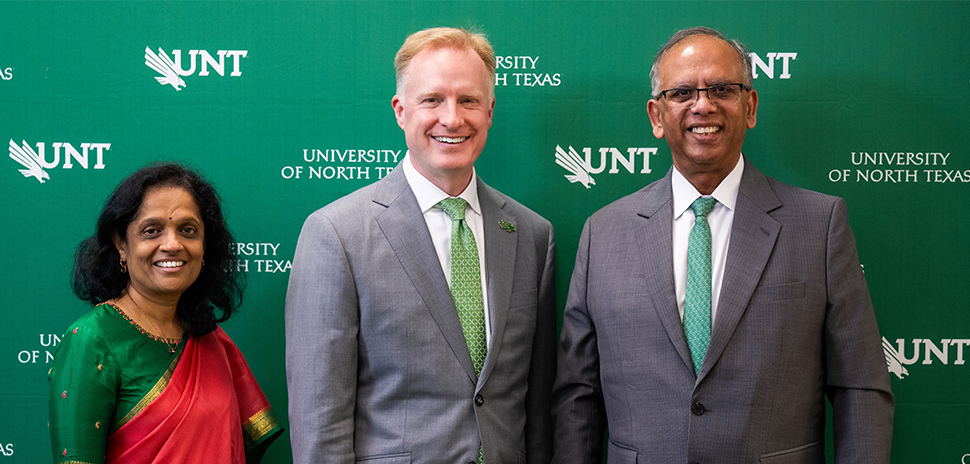
The gift from University of North Texas alum Vikas Sinha and his wife, Anuradha, is the couple’s third to UNT since 2024. It also funds six new endowments for scholarships, research and entrepreneurship.
-

The venture capital-backed company said its engine still decides what’s feasible — even as AI assistants take on more of the legwork.
-

Irving-based Builders FirstSource led a $25.3 million Series A investment as part of a larger partnership with the Vancouver, Washington-based maker of AI software for residential construction.
-

New CBRE research points to a maturing tech workforce in North Texas, fueled partly by the Y’all Street financial services boom.
-
Grants of $100,000 or $200,000 went to research projects not chosen for the 2026 Hill Prizes. Six Texas researchers, including three from Dallas’ UT Southwestern Medical Center, shared the $1 million.
-
 Patented: Citi’s AI-Generated Suspicious Activity Reports and 105 More Inventions Across North Texas
Dallas-Fort Worth ranked No. 9 nationally with 106 patents the week of Sept. 22. One went to Citibank for a system, developed largely by an Irving team, that uses large language models to draft the reports banks must file when they suspect financial crime.
-
Bush, a veteran of Dialexa, Enseo and Sensori Robotics, joins CoPoint AI co-founders John Humphrey and Dipesh Patel to expand the Dallas-based consulting company’s reach.